Thought not really related to the events of this morning, there has been an ongoing problem on the MeshCore network. It is mostly a user education issue and unfortunately there is not a good way to address it other than recommending to user by user that they setup multibyte pathing.
This problem starts with the average user setting up a MeshCore companion and not knowing about the settings that help out the greater MeshCore community. The default settings on a companion defaults to 1-byte paths to maintain compatibilty with the older MeshCore node firmware. Any MeshCore nodes with firmware prior to 1.14.0 (March 2026) are not able to handle multibyte paths. Hence why the default on new firmware installs is till 1-byte paths.
For all the people still new to MeshCore, let me take a few moments to explain what this is all about. Almost every message (for the purpose of this discussion consider this to be all messages) that traverse the MeshCore network have information in the message that records what repeaters have forwarded the message.
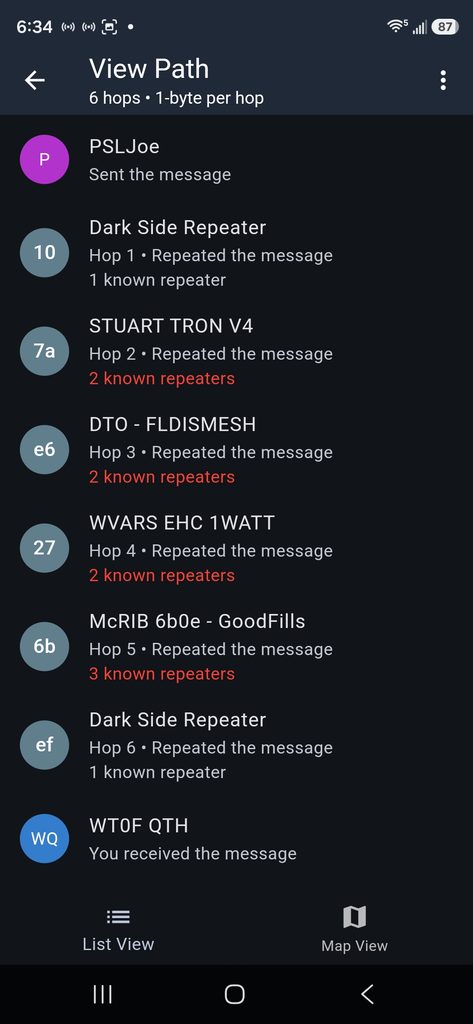
To the right you see the path of a message from this morning. You can do the same thing by doing a long press on a message you received while connected to your companion. You will get a submenu to appear and then you can select “View Message Paths”.
This message was sent using 1-byte paths (you can see this by looking at the top just under the View Path heading. While 1-byte paths do get you across the network it adds confusion and can possibly add a bunch more traffic to the network than what is necessary.
Looking at this path the first thing that pops out is that several of the repeaters have been designed as having multiple known repeaters. This is because with 1-byte paths the total number of unique repeaters without ID collisions is 254 repeaters.
The IDs you are seeing here are the first byte of the repeater’s public key. You remember that very long hexadecimal number that you see in the settings of your companion? Well each repeater has a unique public key also. Once you start getting to have 20-30 repeaters on the MeshCore network you are going to start having ID collisions where the first byte of two or more repeaters have the same hexadecimal digits.
I can tell you that the path that is shown is completely inaccurate because of using 1-byte paths and the order of the contacts in the companion. So let’s walk down the path so you can get a feel of how inaccurate it is. We start with the sender’s companion, PSLJoe, and are pretty much guaranteed that this is correct as there is other portions of the message that verifies the sender.
Next, we have the Dark Side Repeater–but wait! Look at the last repeater that saw the message, again it was the Dark Side Repeater. What PSLJoe sitting right next to me and the message make one big loop? No, this was not the case but an artifact of having an old contact record of an earlier version of the Dark Side Repeater. Notice that the two entries for Dark Side Repeater have different numbers (10 and ef) and the repeater got a new public key at some point when the node was wiped and reloaded with new firmware. What this means is that there is a repeater down near PSLJoe in South Florida that I have not seen an advert from so I have no contact record with the public key of that repeater. If I had seen an advert from that repeater, then that first entry for Dark Side Repeater would also have the red text stating “2 known repeaters”.
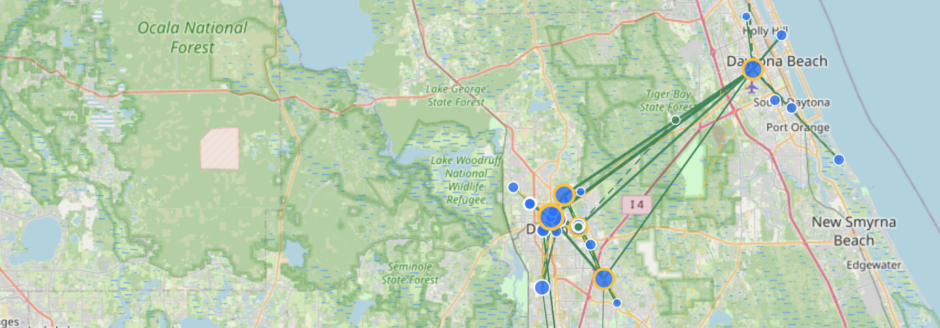
OK, first mystery is more or less solved. Knowing that PSLJoe is in South Florida I can be reasonably confident that the STUART TRON V4 repeater is correct (but I can not be 100% confident because I only know the first byte of the public key). Next the message hits the DTO – FLDISMESH repeater in Orlando. This I can not be certain is correct or not. The ID of e6 could be also the Halimesh repeater in Daytona Beach. Both of the repeaters start with e6. Both of the repeaters are what I refer to tier 1 repeater (please see the repeater standard documentation for a quick overview of the repeater tiers). This message could have come through Daytona Beach just as much as coming through Orlando. There is no way of telling because of the 1-byte path.
The next repeater is WVARS EHC 1WATT and I can tell you that is correct because that is the local tier 1 repeater in my area. Yes, there is another repeater out there using 27, but it is a car repeater probably in South Florida. The next repeater is the tier 2 repeater that I put up, but it is mis-identified because of the 1-byte path. This repeater should be showing as Blue Lake Repeater.
Finally we get back to Dark Side Repeater that is at my house and I know that this entry is correct.
So now that we have ripped apart this path and seen that there is a lot of uncertainty and inconsistencies with 1-byte paths, how can this be made better? Well multibyte paths makes this a lot more precise. If you have MeshCore version 1.14.0 – 1.16.0 on your companion, then in the settings of your companion, scroll down toward the bottom and you will find Experimental Settings. This is where you find the setting to change to 2-byte or 3-byte paths. If you have MeshCore version 1.17.0 or greater you will now find the setting under the Network Settings near the radio settings. Go ahead and update your companion settings now–I will wait……
So what is the different between 2-byte and 3-byte paths? Nothing other than more precision and the maximum number of hops that a message can make. Using 2-byte paths you can make a maximum of 32 repeater hops and using 3-byte paths allows for up to 21 repeater hops. Still more hops than what is needed to get across the state. The message packets do get a little bit bigger (typically 6-10 bytes larger) when 2-byte or 3-byte paths are being used.
Here is the part that may blow your mind. Remember I stated that with 1-byte paths you could only have 254 repeaters before you have an ID collision? Well with 2-byte paths that number jumps to 65,533 repeaters and with 3-byte paths it goes to 16,777,214 repeaters. For all practical purposes 2-byte paths is more than enough to have accurate and precise message path information.
Please do all of us a favor and start using 2-byte paths on all of your companions. If you have a repeater, then I would also suggest you do the same on the repeater. Please see my admin tip concerning multibyte paths on repeaters.